Discover whether average students can get scholarships in professional courses. Learn about scholarship types, eligibility, and strategies to secure financial aid for higher education.
Many students believe that scholarships are only for top rankers or academically brilliant students. This common misconception often discourages average students from even applying for scholarships. In reality, scholarship opportunities today are far more diverse and inclusive than before. Various organizations, governments, and private institutions provide financial assistance to students based on different criteria, not just academic performance.
Professional courses such as engineering, management, computer applications, medicine, and finance can be expensive. Scholarships help reduce financial pressure and allow students to focus on learning and career growth. The good news is that average students can also receive scholarships if they understand the different types of scholarships available and how to apply effectively.
This article explains how average students can get scholarships in professional courses, the types of scholarships available, eligibility criteria, and strategies that can significantly increase the chances of receiving financial support.
Understanding Professional Courses
Professional courses are specialized academic programs designed to prepare students for specific careers. These courses combine theoretical knowledge with practical skills to make students job-ready.
Some popular professional courses include:
- Engineering programs
- Medical and healthcare courses
- Computer applications such as BCA and MCA
- Business and management programs like BBA and MBA
- Commerce and finance courses such as CA, BCom, and MCom
- Law programs such as LLB
These programs often involve higher tuition fees because they provide technical training, industry exposure, and advanced academic resources.
The Myth That Only Top Students Get Scholarships
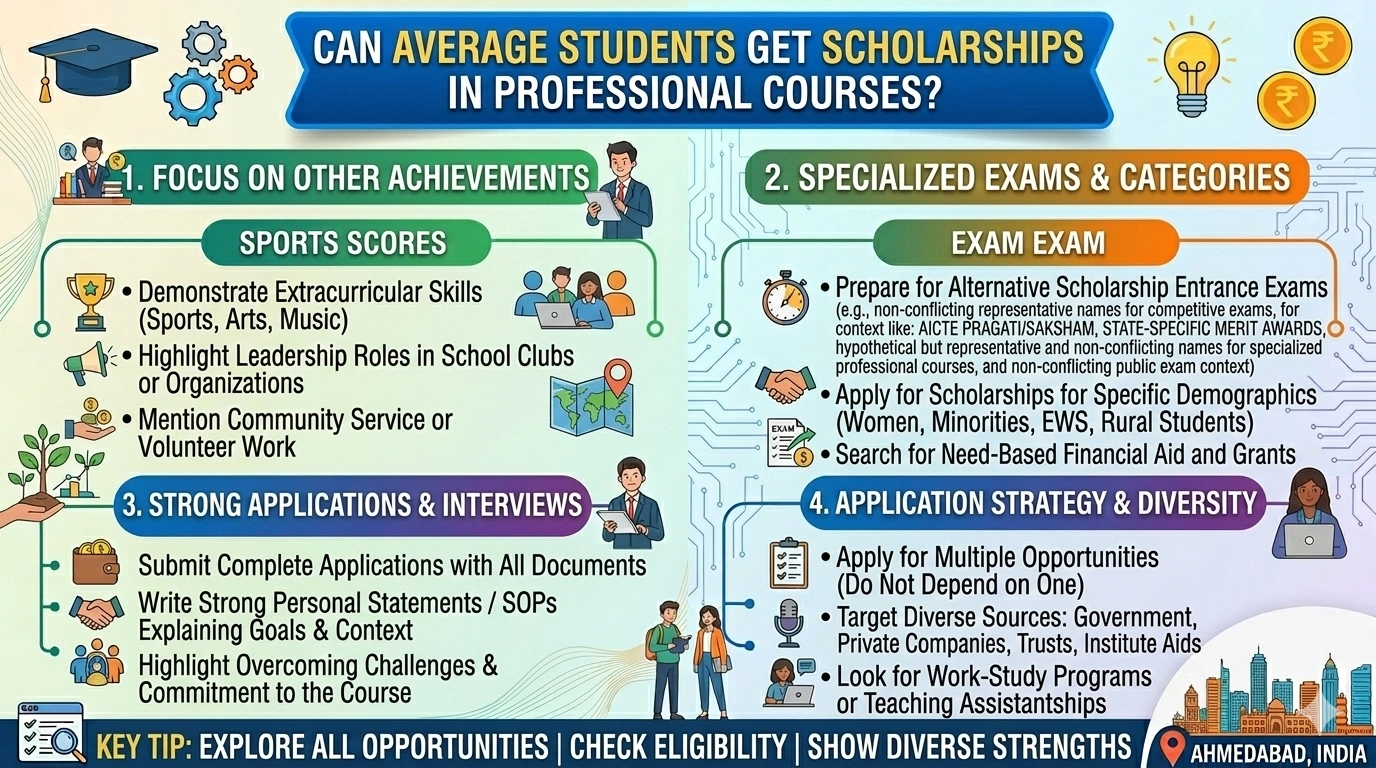
One of the biggest myths about scholarships is that they are reserved only for students with extremely high marks. While merit-based scholarships exist, many other scholarship programs consider additional factors.
Scholarship providers often evaluate:
- Financial background
- Leadership potential
- Community service
- Extracurricular achievements
- Personal motivation
- Talent in specific fields
Because of this broader evaluation approach, average students still have strong chances of receiving scholarships.
Types of Scholarships Available for Average Students
Scholarships are designed to support students from different backgrounds. Understanding the types of scholarships available can help average students identify the best opportunities.
Merit-Based Scholarships
These scholarships are awarded to students who perform well academically. However, many merit scholarships do not require perfect scores. Students with decent academic performance may still qualify.
For example, some institutions offer scholarships to students who maintain consistent grades rather than top ranks.
Need-Based Scholarships
Need-based scholarships focus on the financial situation of the student rather than academic performance.
These scholarships aim to help students from low-income families pursue higher education without financial stress.
Eligibility is usually based on:
- Family income
- Financial background
- Supporting documents such as income certificates
Average students often benefit greatly from need-based scholarships.
Talent-Based Scholarships
Students with talents in areas such as sports, arts, music, writing, or innovation may receive scholarships regardless of academic performance.
Professional colleges often provide scholarships for students who represent their institution in competitions or sports events.
Diversity and Inclusion Scholarships
Many scholarship programs aim to promote diversity and inclusion in education.
These scholarships support:
- Women students
- Students from rural areas
- Students from minority communities
- Students from disadvantaged backgrounds
Such scholarships ensure that more students have equal access to professional education.
Institutional Scholarships
Many colleges and universities offer internal scholarships to their students.
These scholarships may be based on:
- Entrance exam performance
- Academic consistency
- Participation in college activities
- Leadership roles in student organizations
Even average students can qualify if they actively participate in campus life.
Professional Courses Where Average Students Can Get Scholarships
Scholarships are available across many professional courses. Some fields have especially strong scholarship opportunities.
Computer Applications and IT
Courses such as BCA and MCA often have scholarships supported by technology companies and educational institutions.
Students interested in programming, web development, and software development may receive scholarships based on their skills or project work.
Business and Management
Programs like BBA and MBA frequently provide scholarships for students who demonstrate leadership skills or entrepreneurial ideas.
Students who participate in business competitions, internships, or community initiatives often qualify for scholarship programs.
Engineering
Engineering programs have many scholarships available through government schemes, institutions, and private organizations.
Students who show interest in research, innovation, or technical projects may receive financial support even if their academic scores are average.
Commerce and Finance
Commerce students pursuing courses like BCom, MCom, or professional finance certifications can apply for scholarships offered by financial institutions and educational foundations.
Students with strong interest in accounting, business analytics, and finance may qualify for various funding opportunities.
Healthcare and Allied Sciences
Although medical scholarships often prioritize academic excellence, many healthcare-related courses also offer need-based scholarships.
Programs in nursing, pharmacy, physiotherapy, and public health often provide financial assistance to deserving students.
How Average Students Can Increase Their Scholarship Chances
Even if academic scores are not exceptional, students can improve their chances of receiving scholarships by building a strong overall profile.
Focus on Consistent Academic Improvement
Scholarship committees appreciate students who show improvement in their academic performance over time.
Consistent effort and dedication can make a strong impression during scholarship evaluations.
Participate in Extracurricular Activities
Students who actively participate in sports, debates, competitions, or cultural events demonstrate leadership and teamwork skills.
These qualities often strengthen scholarship applications.
Build Technical or Professional Skills
Developing skills related to the chosen professional course can increase scholarship eligibility.
For example:
- Coding projects for computer science students
- Business plans for management students
- Research activities for science students
Skill development shows commitment to career goals.
Volunteer and Contribute to Society
Community service and volunteering activities are highly valued by scholarship providers.
Students who contribute to social initiatives demonstrate responsibility, empathy, and leadership potential.
Write a Strong Scholarship Essay
Many scholarships require applicants to submit essays explaining their goals, achievements, and motivations.
A well-written essay can significantly improve the chances of winning a scholarship.
Students should focus on:
- Career aspirations
- Personal challenges
- Commitment to education
- Future contributions to society
Apply for Multiple Scholarships
Students should not rely on a single scholarship opportunity.
Applying for multiple scholarships increases the probability of receiving financial assistance.
It is advisable to research scholarships offered by:
- Government organizations
- Private foundations
- Universities and colleges
- Corporate companies
Common Requirements for Scholarship Applications
Most scholarship applications require specific documents and information.
Typical requirements include:
- Academic transcripts
- Admission proof to a professional course
- Identity documents
- Income certificate for need-based scholarships
- Recommendation letters
- Personal statement or essay
Students should prepare these documents in advance to avoid missing application deadlines.
Challenges Average Students May Face
Although scholarships are accessible to many students, average students may face certain challenges during the application process.
Common challenges include:
- High competition for limited scholarships
- Lack of awareness about available programs
- Incomplete applications or missing documents
- Fear of rejection
These challenges can be overcome with proper preparation and research.
The Role of Colleges in Supporting Scholarship Applications
Many colleges assist students in finding and applying for scholarships.
Institutional support may include:
- Scholarship guidance from academic advisors
- Workshops on scholarship applications
- Information about external funding opportunities
- Assistance with documentation
Students should regularly communicate with their college administration to stay informed about scholarship programs.
Long-Term Benefits of Scholarships
Scholarships provide more than financial assistance. They also offer long-term advantages that help students build successful careers.
Benefits include:
- Reduced education expenses
- Increased academic motivation
- Opportunities for networking and mentorship
- Recognition of student achievements
- Better career opportunities after graduation
Students who receive scholarships often gain confidence and motivation to pursue ambitious goals.
The Future of Scholarship Opportunities
Scholarship opportunities are expanding as education becomes more accessible and industries seek skilled professionals.
Emerging fields such as artificial intelligence, data science, digital marketing, and sustainable development are receiving increasing scholarship support.
Students who choose professional courses in these growing fields may find more funding opportunities in the future.
Conclusion
Average students should never assume that scholarships are beyond their reach. Modern scholarship programs recognize that talent, determination, and potential come in many forms. Academic marks are only one part of the evaluation process.
Professional courses in fields such as computer science, management, engineering, commerce, and healthcare offer numerous scholarship opportunities. By focusing on skill development, extracurricular participation, and strong scholarship applications, average students can successfully secure financial support for their education.
The key is to stay informed, apply to multiple scholarship programs, and present a strong overall profile. With the right approach and determination, even average students can achieve their educational goals through scholarships.
FAQs
1. Can average students really get scholarships in professional courses?
Yes, many scholarships consider financial need, extracurricular activities, leadership potential, and talents in addition to academic marks.
2. What types of scholarships are available for average students?
Average students can apply for need-based, talent-based, diversity scholarships, institutional scholarships, and private foundation scholarships.
3. Do scholarships require very high marks?
Not always. Some scholarships require good academic performance, but many focus on other factors such as financial need or skills.
4. Which professional courses offer scholarships?
Courses such as engineering, computer applications, business management, commerce, and healthcare often have scholarship opportunities.
5. Can extracurricular activities help in getting scholarships?
Yes, participation in sports, cultural activities, competitions, and leadership roles can strengthen scholarship applications.
6. How many scholarships can a student apply for?
Students can apply for multiple scholarships as long as they meet the eligibility criteria.
7. Are scholarships available for private colleges?
Yes, many private colleges offer institutional scholarships and financial aid programs.
8. Do scholarships cover full tuition fees?
Some scholarships provide full funding, while others offer partial financial assistance depending on the program.